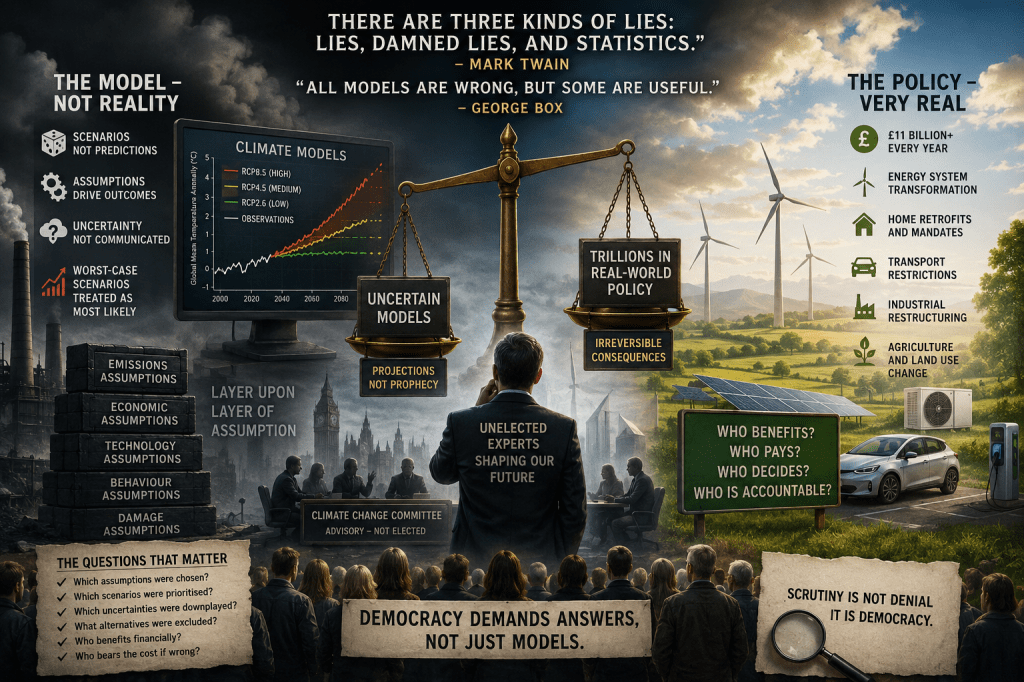
“There are three kinds of lies: lies, damned lies, and statistics.” — Mark Twain
“All models are wrong, but some are useful.” — George Box
For much of the British public, climate policy is increasingly presented not as a democratic debate, but as a scientific inevitability. Politicians, quangos, advisory bodies, and campaign groups frequently speak in the language of certainty , declaring that there is only one acceptable pathway for the nation’s energy system, economy, transport network, agriculture, housing, and industrial future.
Yet beneath this apparent certainty lies something far less solid:
layers of statistical modelling, scenario assumptions, economic projections, and long-range forecasting stretching decades into the future.
The issue is not whether climate risk exists. The issue is whether the public is being told the difference between measured reality and speculative projection.
Modern UK climate policy is built heavily upon modelling frameworks derived from the IPCC, UKCP18 climate projections, and the recommendations of the Climate Change Committee. These models are not direct observations of the future. They are conditional simulations based on assumptions regarding emissions, demographics, economics, technological progress, land use, energy systems, and political behaviour.
If those assumptions change, the outcomes change.
For years, some of the most extreme warming pathways , particularly RCP8.5 , were repeatedly used throughout climate risk assessments, adaptation planning, infrastructure policy, and public communications. Yet even parts of the scientific community now acknowledge these scenarios are increasingly implausible as baseline futures. They were designed primarily as high-end stress tests, not necessarily as the most likely outcome.
And yet worst-case modelling frequently migrated into mainstream policymaking.
This matters because modern British policy is now being reshaped around these projections:
vast grid expansion,
industrial restructuring,
farmland conversion,
heat pump mandates,
restrictions on hydrocarbons,
accelerated electrification,
and trillions in long-term infrastructure liabilities.
When unelected advisory structures recommend that Britain spend tens of billions annually based upon scenario-driven modelling, democratic scrutiny becomes not merely reasonable, but essential.
The problem is compounded by the way uncertainty is communicated. Climate models contain recognised limitations involving:
cloud feedbacks,
precipitation forecasting,
regional weather behaviour,
aerosol effects,
tipping point probabilities,
and economic damage estimation.
Scientific uncertainty is normal. It is inherent in all complex modelling systems.
But uncertainty is often translated politically into certainty language:
“the science is settled,”
“experts agree,”
“there is no alternative.”
That is not how scientific inquiry traditionally functions. Science advances through challenge, revision, refinement, and scrutiny.
At the same time, there appears to be a profound imbalance in the way risks are assessed. Government institutions extensively model:
carbon risk,
flood risk,
heat risk,
and emissions trajectories,
yet far less attention is given to modelling:
grid instability,
deindustrialisation,
rising electricity costs,
energy dependency,
supply chain fragility,
land-use conflicts,
or the economic consequences of accelerated Net Zero policies themselves.
The public is therefore presented with a one-sided risk framework: the risks of not pursuing Net Zero are modelled relentlessly, while the risks created by the transition itself are often politically minimised.
This is no longer merely an environmental discussion. It is a constitutional and economic question.
The Climate Change Committee was established as an advisory body under the Climate Change Act 2008. Yet over time, its influence has expanded far beyond advice. Carbon budgets and climate targets now shape national infrastructure planning, energy investment, housing regulation, transport policy, industrial strategy, and public spending priorities across multiple departments.
In practice, Britain increasingly operates through a form of technocratic governance where long-term national policy is heavily directed by statistical modelling and advisory frameworks that ordinary voters neither elect nor meaningfully control.
That is why scrutiny matters.
Models are useful tools. They can help governments assess risk and plan infrastructure. But models are not prophecy, and projections are not mandates. When statistical assumptions become the basis for irreversible national transformation, democratic accountability must remain stronger than algorithmic authority.
The British public has every right to ask:
Which assumptions were chosen?
Which scenarios were prioritised?
Which uncertainties were downplayed?
Who benefits financially?
What alternatives were excluded?
And who ultimately bears the cost if the models are wrong?
Those are not anti-scientific questions.
They are the very questions a democratic society is supposed to ask.
Shane Oxer. Campaigner for fairer and affordable energy
 SAY NO TO THE DESTRUCTION OF OUR LAND
Leave a comment