Who truly governs Britain:
The politicians we elect every few years, or the web of unelected frameworks, statutory targets, quangos, regulators, and international commitments that persist regardless of the ballot box result?
This is the question more of the public is beginning to ask.
Examine the legislation, the carbon budgets, the infrastructure pipelines, and the long-term policy direction. It is increasingly clear that modern governments do not fully set the agenda they campaign on. They inherit and manage an established framework set largely elsewhere.
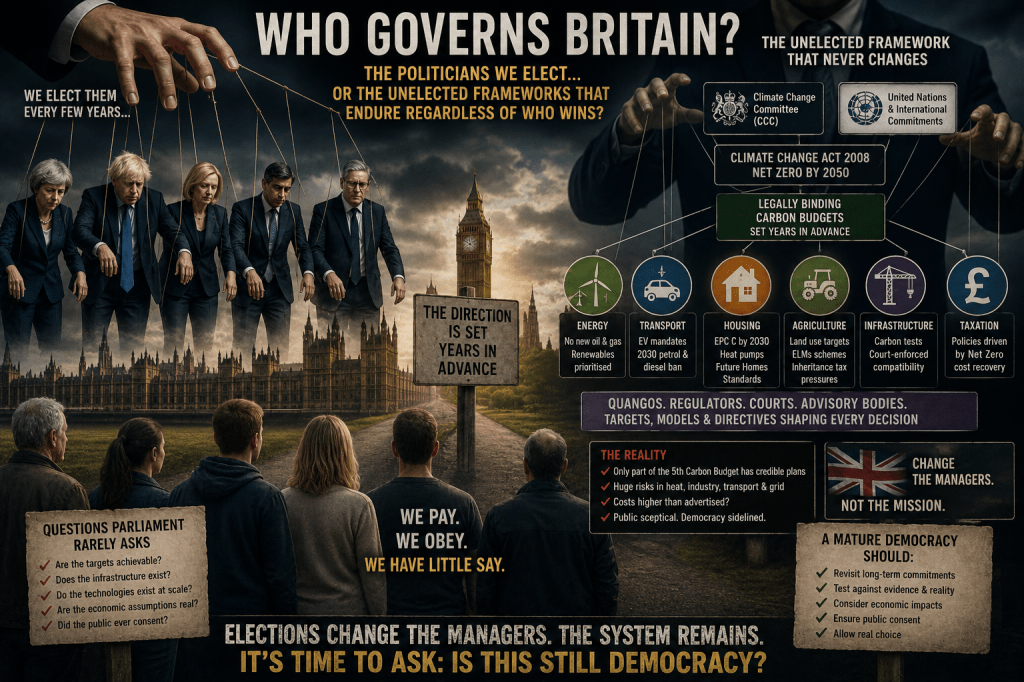
Legally binding carbon budgets, Net Zero targets, climate directives, emissions pathways, and the pronouncements of arms-length bodies now shape core decisions on:
energy policy,
transport infrastructure,
housing standards and planning,
industrial strategy,
agriculture and land use,
major infrastructure spending,
and taxation priorities.
Governments change. Prime Ministers come and go. Yet the underlying trajectory has remained strikingly consistent , from Labour to the Coalition, the Conservatives, and back to Labour. The direction barely shifts.
Why? Because the framework is embedded in statute and institutions that outlast any single parliament:
The Climate Change Act 2008,
the legal commitment to Net Zero by 2050,
five-yearly carbon budgets,
the Climate Change Committee and associated regulators,
international agreements,
and a network of regulatory and judicial obligations stretching decades ahead.
Elected governments increasingly function as delivery agents for pre-set targets rather than sovereign deciders of the national course.
No major party has mounted a fundamental challenge to this structure. Serious parliamentary scrutiny of the targets’ achievability, the realism of the underlying economic and technical assumptions, infrastructure readiness, costs, or the extent of explicit public consent has been notably limited.
This has ceased to be solely a debate about climate policy. It has become a constitutional one.
When long-term targets are made legally binding and reinforced by quangos, courts, regulators, and treaty obligations, elections risk changing only the managers , not the mission. That raises a deeper democratic question:
Has Britain drifted from representative government toward technocratic governance, where statistical models, long-range frameworks, and expert committees set the parameters that politicians merely administer?
A mature democracy must retain the ability to revisit major long-term commitments. It should test assumptions against economic reality, engineering constraints, technological progress, fiscal sustainability, and. most importantly , ongoing public consent. Treating such commitments as immutable articles of faith undermines the principle that power ultimately flows from the electorate.
If voters cannot meaningfully alter the country’s strategic direction at the ballot box, the inevitable question becomes:
Who really governs the United Kingdom?
 SAY NO TO THE DESTRUCTION OF OUR LAND
Leave a comment