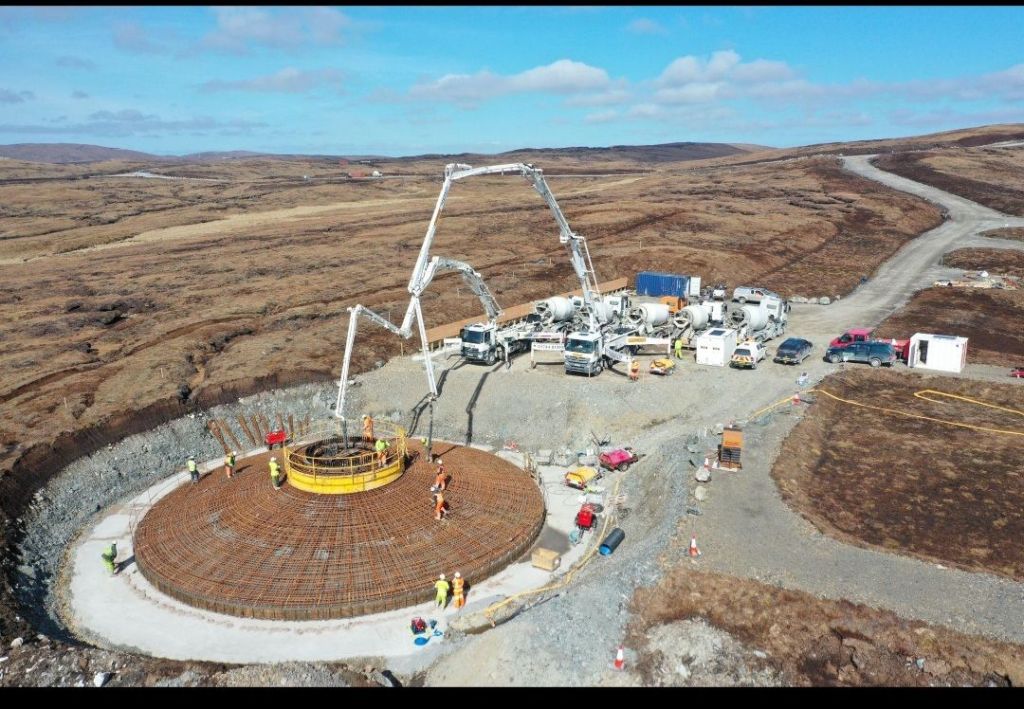
Look closely at this image.
What you are seeing is not a footpath improvement.
Not habitat restoration.
Not landscape recovery.
What you are looking at is a massive reinforced concrete turbine foundation, being poured into upland terrain. an industrial platform designed to anchor wind turbines approaching 200 metres in height.
This is what “green infrastructure” often looks like when the brochures are put away.
For many, this is presented as progress.
A clean energy transition.
A necessary sacrifice.
A contribution to Net Zero.
But for those following what is now unfolding at Hope Moor ,and similar proposals such as Calderdale Energy Park. A serious question must now be asked:
Are we reducing environmental damage… or simply relocating it?
The Forgotten Value of Britain’s Peatlands
Britain’s upland peatlands are not empty wasteland.
They are among the most important ecosystems in the country.
Peatlands store vast quantities of carbon accumulated over thousands of years. They regulate water flows, help reduce downstream flooding, filter drinking water, and provide habitat for some of Britain’s most vulnerable species.
When healthy, peat is one of nature’s most powerful carbon capture systems.
When disturbed, drained, excavated, compacted, or fragmented by roads, trenches, foundations, and heavy machinery…
it can become a carbon source instead of a carbon sink.
That is the reality rarely shown in glossy consultation brochures.
The Turbines Are Only the Beginning
When developers talk about 24 turbines, most people imagine towers on a skyline.
But turbines do not stand alone.
Each one brings an industrial footprint that extends far beyond the visible structure:
Deep reinforced concrete foundations
Underground cable corridors linking turbine arrays
New heavy-duty access roads
Crane pads and laydown compounds
Grid connection infrastructure
Transformer compounds and switching stations
Long-term maintenance access
This is not temporary disruption.
This is permanent industrial engineering placed into living landscapes.
And once peat is excavated, compressed, or hydrology is altered…
you do not simply “put it back.”
The Carbon Question Nobody Wants to Answer
We are repeatedly told these projects exist to reduce carbon emissions.
But where is the full carbon accounting for:
Excavating peat soils?
Pouring thousands of tonnes of concrete?
Steel reinforcement?
Transporting turbine sections across upland roads?
Ongoing grid infrastructure and maintenance?
At what point does the public get shown the whole lifecycle footprint, rather than the generation figure alone?
Because if the carbon locked beneath the moor is disturbed in the process of “saving the planet,” then the public deserves full transparency.
Once Industrialised, It Rarely Returns
Hope Moor is not an industrial estate.
It is part of a living upland landscape shaped by geology, wildlife, grazing, heritage, and generations of local stewardship.
Once roads are cut…
Once foundations are poured…
Once cables are buried…
Once substations arrive…
The character of the moor changes permanently.
The turbines may last 25 years.
The footprint beneath them may last far longer.
Now Is the Time to Speak
This is not about being “for” or “against” renewable energy.
It is about honesty.
It is about whether communities are being shown the full reality of what is proposed in their countryside.
Hope Moor deserves scrutiny.
Hope Moor deserves transparency.
And Hope Moor deserves a public willing to ask difficult questions before it is too late.
Have your say here:
https://hopemoor.co.uk/share-your-views/feedback-form/about-you/
Campaign research:
Is This What Net Zero Looks Like? Deep Peat, Concrete, and the Battle for Hope Moor and Calderdale
https://reformdoncasteractionagainstnetzero.blog/2026/05/13/the-battle-for-hope-moor-part-vi/
Shane Oxer. Campaigner for fairer and affordable energy
 SAY NO TO THE DESTRUCTION OF OUR LAND
Leave a comment